
Outlook
Part of What the creator contracts outlook means for sponsorship agreements
What AI applications in creator contracts mean for sponsorship deals
AI applications are appearing inside sponsorship agreements. What that changes for ad disclosure, liability and evidence in England, and review triggers to watch.
What to take away
- AI terms in creator contracts can allocate risk between the parties, but they do not remove advertising or consumer-protection duties. For wider UK context, see regulators have published guidance.
- The Advertising Standards Authority (ASA) applies CAP Code rule 2.1, which requires ads to be obviously identifiable, and rule 2.3, which addresses misleading omissions and presentation. AI drafting does not exempt a post from either rule.
- A decision table helps you choose terms by deal type rather than copying a competitor's clause.
- Treat every AI term as an update trigger, reviewed whenever the platform, the tool or the regulator moves.
- Individual cases need a qualified adviser before signing.
The Department for Business and Trade holds the policy remit covering advertising, consumer protection and business support, so its priorities shape how disclosure expectations reach creators. Most AI terms in creator deals are drafted privately, which means the practical rules arrive in the agreement you sign.
Where AI terms sit in the agreement
What a tool use clause usually covers
A tool use clause normally names the permitted tools, the outputs they may touch, and who checks the result before publication. It may require the creator to keep prompt or draft records. None of this displaces the disclosure duty: if a post is paid, it is an ad. The clause decides who carries the cost when something goes wrong.
Illustrative wording: 'The Creator may use ChatGPT, Adobe Firefly or Canva Magic Studio for draft captions only. The Creator must check and edit all output before publication. The Creator must keep the final caption and a prompt log for 12 months.'
The contract should also state who owns or may use the final caption, image and other outputs, and whether the creator or brand must check that third-party material is cleared. Under section 9(3) of the Copyright, Designs and Patents Act 1988, the author of a computer-generated work is the person who made the arrangements necessary for its creation. That does not mean that a prompt automatically gives the creator ownership; spell out ownership, licences and permitted reuse in the agreement.
Prompts can contain personal data or confidential campaign information. The UK GDPR and Data Protection Act 2018 may apply to that processing, so set out what information may be entered into a tool, what safeguards are required and whether records may be retained. The Information Commissioner's Office (ICO) publishes AI and data protection guidance for organisations using AI.
Tool use clause checklist
- Name the permitted tools
- List the outputs they may touch
- Say who checks the result
- Require prompt or draft records
- Set correction duty and timing
- State if payment can be withheld
A well-drafted clause also sets out what happens when the tool produces something inaccurate. It should say who corrects the copy, how quickly, and whether the sponsor can withhold payment until the post is fixed.
Why the clause wording matters more than the tool name
The Administration of Justice Act 1985 governs how company records and disclosures are made, a reminder that formal records carry legal weight. If a sponsorship agreement requires you to certify that disclosure was present, that certification is a record. Vague wording about AI assistance makes it hard to defend.
Keep the paper trail short and specific. A dated approval email from the brand, a saved final caption, and a note of the tool used will usually answer a complaint better than a general assurance that processes were followed.
For the linked guidance on terms that recur, see creator contracts trends and outlook for England in 2027.
Choosing terms deal by deal
Use a decision table, not a template
Copying a clause from another deal is the common mistake. The right term depends on who holds the account, how the content is published, and what the brand must prove later.
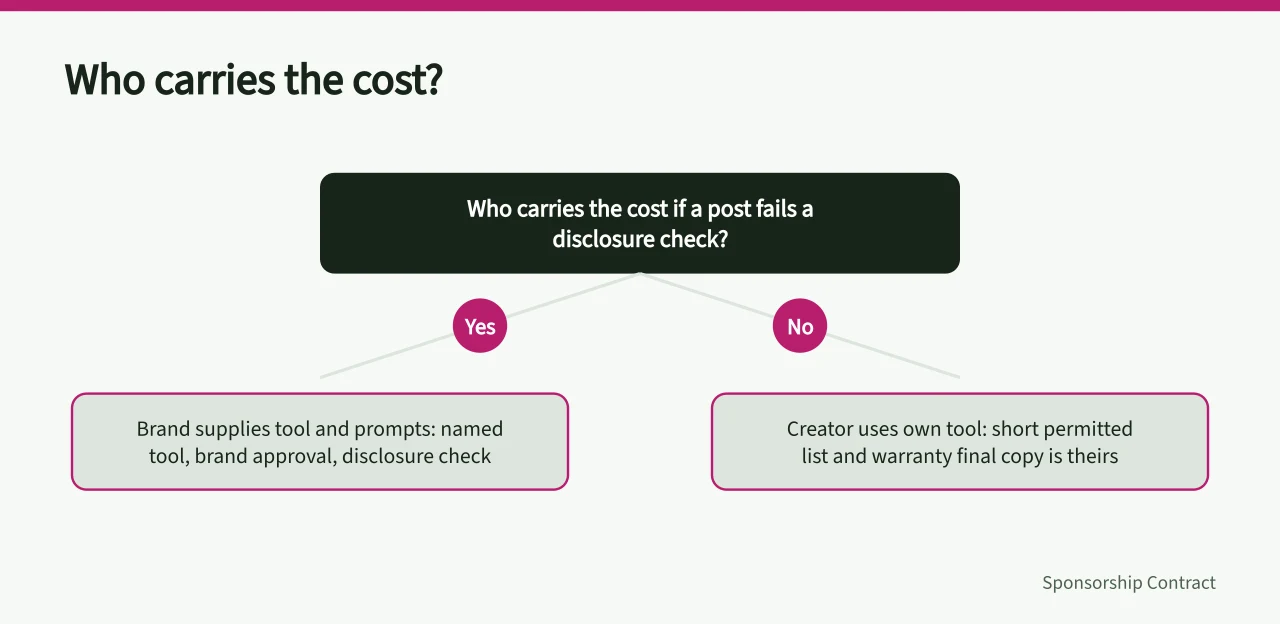
Choose
- Brand supplies the tool and prompts
- A named tool, brand approval, and a disclosure check before publishing
- Creator uses their own tool for drafts
- A short permitted list and a warranty that final copy is theirs
- Paid post on a labelled platform
- The label plus a caption disclosure
- Long-term retainer with monthly posts
- A quarterly review point and a notice period
- Regulated category, such as finance
- Compliance sign-off
Avoid
- Brand supplies the tool and prompts
- Silent use of brand tools
- Creator uses their own tool for drafts
- An open clause covering any tool at any time
- Paid post on a labelled platform
- Relying on the label alone
- Long-term retainer with monthly posts
- A fixed term with no review trigger
- Regulated category, such as finance
- Creator discretion on claims
Read the table by asking who carries the cost if a post fails a disclosure check. CAP Code rule 1.7 places primary responsibility for observing the Code on marketers, publishers and other participants in marketing communications. Name the brand approver and the person responsible for publishing and correcting the post. An indemnity can allocate losses between the contract signatories, but it cannot bind the ASA, the CMA or consumers.
Worked example: a paid Instagram post for a skincare brand where the brand supplies Canva Magic Studio. Row 1 applies, so name Canva Magic Studio, require brand approval, and put a disclosure check before publishing.
For a creator-selected tool, illustrative wording could limit its use to draft copy, prohibit entering confidential or personal data without approval, and require the creator to check the final post. Where the brand supplies the tool or its inputs, the agreement can require the brand to confirm it has rights to those inputs and identify who gives final approval. In either case, specify who corrects a disclosure failure and what happens to payment while it is being fixed.
How liability terms shape the risk
Do not infer liability from the fee or from who supplied the tool. The agreement should state the fee, the scope of any indemnity, any liability cap and any exclusions, as well as whether payment can be withheld while a post is corrected. Those amounts and limits are deal-specific; write them into the agreement rather than relying on an assumed standard. Read the indemnity before agreeing to flexibility, and test the downside in our creator contracts risk scenarios in England.
Update triggers to watch
Contract triggers
Review the contract when the named tool or its terms change, the platform changes its labelling features, the brand changes its approval chain, or the parties change how AI-generated material is used. Check that the permitted-use clause, data restrictions, approval process and responsibility for corrections still match the deal.
External triggers
Watch for changes to the CAP Code or new ASA/CAP advice on AI-generated advertising, CMA consumer-protection guidance, ICO AI and data protection guidance, and UK Intellectual Property Office (IPO) guidance on copyright. Recheck the label against the ASA's Influencer's Guide to making clear ads: it should be clear and prominent, not dependent on whether AI was used.
Common questions
Does using AI change the disclosure requirement?
No. The duty to disclose a paid partnership rests on the commercial relationship, not on who drafted the words.
Can a brand's indemnity remove the creator's disclosure responsibility?
No. An indemnity can set out how the brand and creator share losses between themselves, but it does not change the CAP Code or prevent a regulator from considering the conduct of the parties involved. The contract should name who checks the label, who approves publication and who must correct an omission.
Can I put personal data into an AI prompt for a campaign?
Do not assume that a prompt is private or exempt from data-protection rules. The UK GDPR and Data Protection Act 2018 may apply when personal data is entered into or processed by a tool. Check the ICO's AI and data protection guidance and agree what information can be used, with what safeguards, before prompting.