
Measurement
Part of Count the view or count the click, measurement terms for creator contracts
Creator contracts: the three metrics to define
Creator contracts need three metric families — performance, disclosure and consent. Here is how to define each, keep evidence and report on a UK campaign.
What to take away
- Since the CAP Code, enforced by the Advertising Standards Authority, and UK data protection rules settled, creator contracts have needed three metric families: performance numbers, disclosure evidence and consent records.
- One number per family is enough for most deals, provided the definition is written into the sponsorship agreement before the campaign runs.
- Origin, the cross-media measurement programme run by ISBA, is changing how UK advertisers compare creator activity with other channels, so comparable figures are now requested.
- Keep raw platform exports and consent records for the retention period in the contract; disputes are usually about evidence, not the headline figure.
- This is general guidance, and individual cases need a qualified adviser.
Why the metrics question changed in the UK
For years a creator contract could be signed on follower count and a screenshot of reach. That no longer holds: the Advertising Standards Authority rules on the paid partnership label under the CAP Code, and the Competition and Markets Authority treats a misleading endorsement as a consumer law matter.
ISBA's Origin cross-media measurement initiative builds a common standard across media, so creator campaigns are judged on whether their figures compare with other channels.
Data protection duties also apply. The Data Protection Act 2018 sits alongside the UK GDPR, whose Article 5 principles govern how a brand and creator handle audience data. The Information Commissioner's Office is the regulator for both.
Budget pressure adds to it. A brand paying for creator work alongside search and display wants one set of terms across the plan. Where the creator figures use a different definition, the reporting line cannot be reconciled and the spend looks unaccounted for. Defining the metric in the contract is cheaper than explaining the gap later.
The three metric families
Metric one is performance. Views, watch time, saves and clicks are the usual set. Pick no more than five and define each in the contract, including platform, reporting window and whether the figure is organic or paid.
Three metric families
- Performanceviews, watch time, saves, clicks
- Disclosurepaid partnership label record
- Consentwhat data is shared and why
- Data handlingretention period and deletion
- Report all three together
Metric two is disclosure. You need a record that the paid partnership label was applied, because the CAP Code requires it. The Advertising Standards Authority publishes guidance for influencers and creators on how the label should appear, and the IAB UK digital video creative principles cover creative practice for video ads, the format most creator deals use.
Metric three is consent and data handling. If the creator shares audience data, the contract should say what is shared, why, how long it is kept and who deletes it.
All three should sit on the same reporting calendar, agreed before the campaign starts, so the figures and the evidence arrive together.
The three are not equal in weight. A performance figure with no disclosure evidence cannot show whether the post was labelled, and a consent record on its own cannot show whether the campaign worked. Report them together.
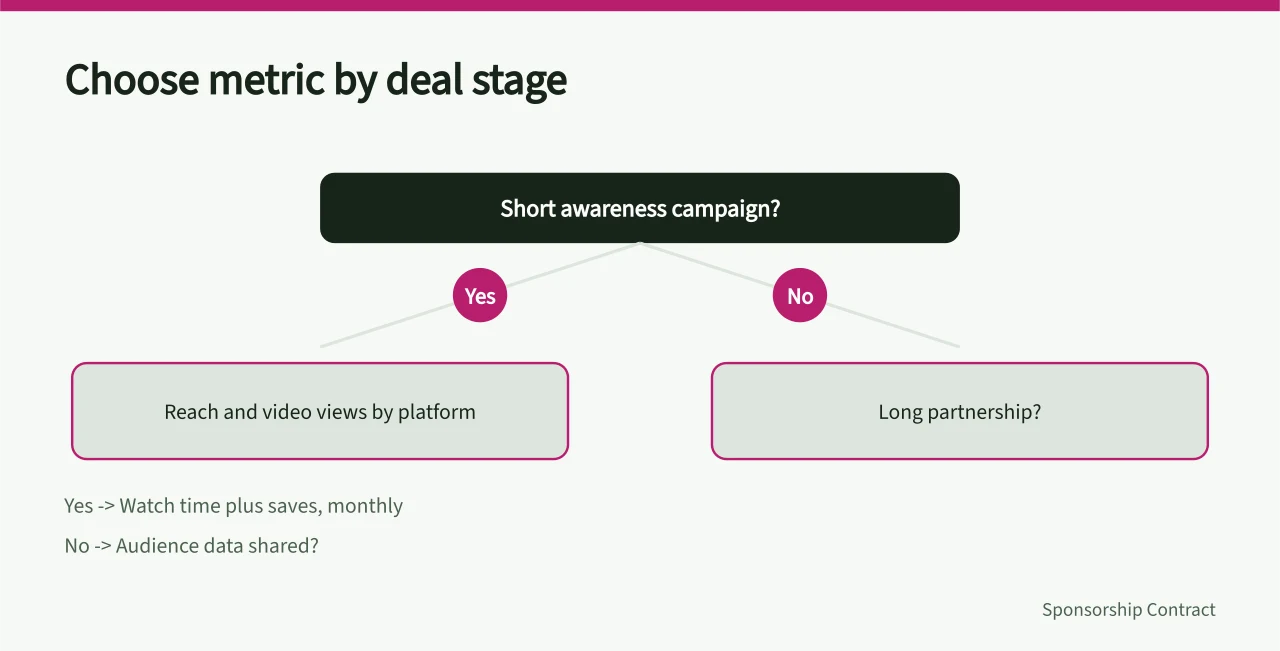
Choose the right metric for the deal stage
Choose
- Short awareness campaign with a single post
- Reach and video views by platform and window
- Long partnership with several deliverables
- Watch time plus saves, reported monthly
- Creator sends audience data to the brand
- Consent records and a stated retention period
- Brand needs figures comparable with other media
- A measure aligned to the Origin framework
Avoid
- Short awareness campaign with a single post
- Blended engagement rate across platforms
- Long partnership with several deliverables
- One total figure for the whole term
- Creator sends audience data to the brand
- Exports kept with no deletion date
- Brand needs figures comparable with other media
- Screenshots as the only evidence
How to define a metric in the contract
A usable definition names the platform, the reporting window and the counting rule. For example, a team paying £400 a month for a creator retainer might define views as platform-reported views in the first seven days after publication, organic only.
Two people reading the same number should reach the same conclusion. If the definition needs a call to explain it, it is not finished.
What to do when the figures disagree
Disagreement is normal. Platform dashboards, creator screenshots and third-party tools rarely match. The contract should name one source of truth and one fallback, and say who resolves a gap larger than an agreed margin.
Attribution is the usual cause: post-level and campaign-level attribution produce different totals, so the contract should say which one the reported figure means.
Reporting habits that keep a deal clean
Report on a fixed date each month, even when the numbers are flat. A short report with three metric families beats twenty numbers.
Store the evidence with the report. Platform exports, label screenshots and consent records belong in one folder per campaign.
Name an owner for each report. One person should be able to produce the folder and the figures within a day of a request, from either side of the deal.
Set a review point. A twelve-week campaign might review at week four and week eight, so the deal is adjusted rather than argued about at the end.
Common questions
Which metric matters most in a creator contract?
None on its own. A contract is defensible when performance, disclosure and consent each have at least one defined number or record, and when it names the source of truth.
Can a creator refuse to share audience data?
Yes, and the contract should allow that. Where data is shared, the UK GDPR principles apply, and the Information Commissioner's Office enforces them, so both sides need a lawful reason and a retention period.
How long should evidence be kept?
The contract should state a period, often the campaign term plus a set number of months. Keep exports and label records together so they can be produced quickly if a claim is questioned.